
In the spring of 1998, nu metal was closing in on its prime. Born out of Bakersfield four years prior with Korn’s self-titled, the genre was “killing the business” as it pertained to guitar solos, drawing a line under the flashy showmanship of the hair metal wave of the late Eighties, while piggybacking off the angst and riffing of the grunge movement of the early Nineties. Nu metal, red-headed stepchild though it may have been, was only months away from its watershed moment on August 18th, in which Korn’s Follow the Leader, Orgy’s Candyass, and Kid Rock’s Devil Without A Cause would all release and break the mold. Months prior, Sevendust’s debut album had just been released, as had Deftones’ game-changing Around the Fur.
As for professional wrestling, the Attitude Era had been kicked off properly on the December 15th, 1997 episode of WWF Raw Is War, when owner/chairman Vince McMahon broke the fourth wall, talking about fans “having their intelligence insulted.” The opening theme song for the show being “Thorn In Your Eye” in all of its unintelligible vocal glory, as well as the iconic “We’re All Together Now” used as buffer music (though we will just gloss over the fact that these songs were released on the WWF Full Metal compilation two years prior).
Outside of WWF, ECW was in its heyday, just one year removed from its inaugural Barely Legal pay-per-view, Mass Transit incident notwithstanding. The renegade promotion took the old Def Leppard line “it’s better to burn out than fade away” to heart, making a massive impression on the wrestling world at large with characters such as the cult leader Raven, the everyman Sandman, and the imports from Japan and Mexico that would later lead to the rise of junior heavyweight / cruiserweight wrestling in North America.
For many, WrestleMania XIV is the firm turning point, as it saw the end of the Winged Eagle design for the WWF Championship and the shift to the Big Eagle that is most associated with this era. In the show’s main event, “Stone Cold” Steve Austin won the title from D-Generation X leader Shawn Michaels, in the final televised match for the latter for over four years. Elsewhere on the card, The Rock coined his legendary catchphrase “do you smell what The Rock is cooking?” while The Undertaker and Kane had their historic first in-ring encounter, in a battle of the titans that made for incredible sports-entertainment hyperbole.
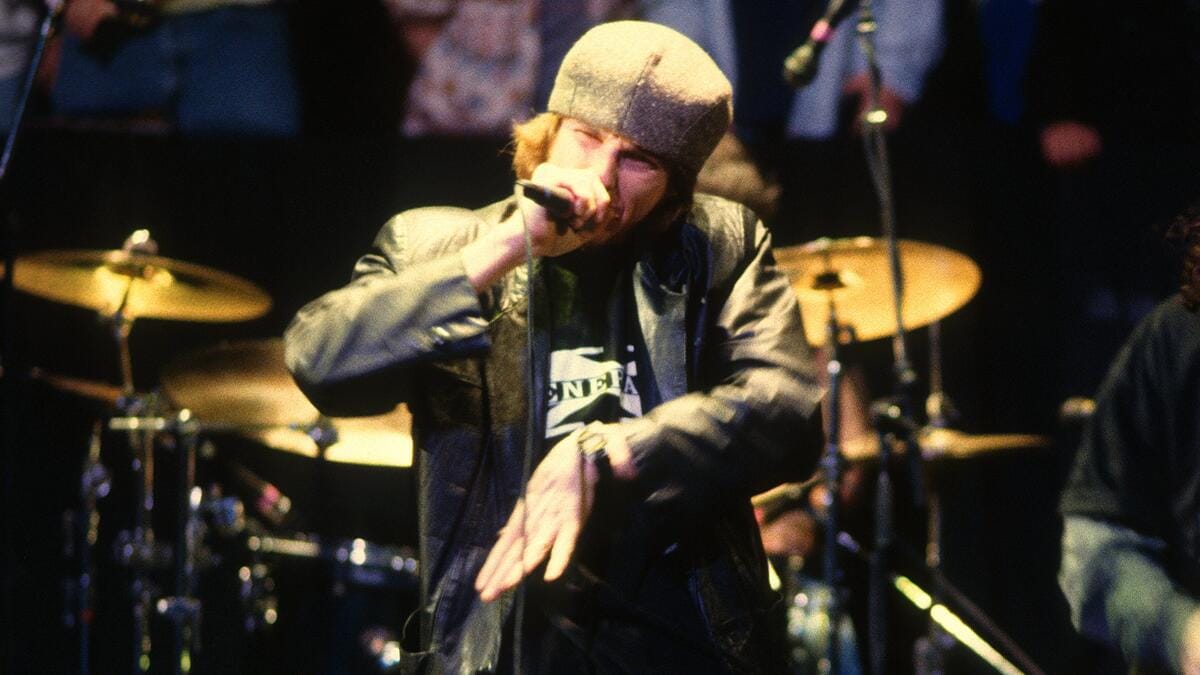
At the top of the broadcast, though, in the grand spirit of Nineties media on the whole, Chris Warren and the DX Band played “America The Beautiful” in a style that can best be described as “we have Rage Against The Machine at home.” Ring announcer Howard Finkel introduced the band and their “alternative new wave versions of the themes ‘America the Beautiful’ and our national anthem,” and the crowd begins booing the band out of the building from the first line of “The Star-Spangled Banner,” and it only gets worse when Warren’s talk-singing turns into screams. Sure, patriotism is a hell of a drug, but it may be fair to call this a bastardization of the track, and the Boston crowd on hand thought so as they rained down their dejection. Jim Ross touted that “only in the US of A and the WWF can there be this type of freedom of expression,” in a line that had to have been fed to him from the production team in the back, in a vain effort to get the segment over.
Given that said performance was edited off of future broadcasts of the show, as well as on the WWE Network and now Netflix… mission not accomplished. That said, it did tick Vince McMahon’s boxes, at least according to Warren himself, who talked about the reaction in a 2007 interview with Squared Circle Radio. Given that McMahon was the sole arbiter for what would and wouldn’t fly, network executives be damned, that was good enough for Warren.
The DX Band would play D-Generation X’s Triple H and Shawn Michaels for their respective European and WWF Championship matches, though in these instances, they stuck to the green-laden stable’s classic entrance theme, with the boos from the crowd coming more from the fact that the stable were heels than the band’s butchering of an American tradition. Interestingly, special enforcer and double agent “Iron” Mike Tyson enters to a remixed version of the DX theme, which would later be adapted into the theme for X-Pac, who would join the faction the next night on Raw is War.
Despite his extensive work with the WWF in its biggest boom period, Chris Warren is a name that is long forgotten to time. For one, The DX Band would be brought back later that year to play Triple H down for his SummerSlam ladder match against The Rock for the Intercontinental Championship, though this performance would be a bit rougher around the edges than any of those at WrestleMania. His work impressed WWF composer Jim Johnston so much that he kept bringing him back through 2000, with another of his iconic performances being on “My Time,” which was at different points the theme for Triple H, Chyna, and later of Stephanie McMahon-Helmsley. Put simply, Warren looks and sounds like Zack De La Rocha to a point, and given that Johnston drew from Rage Against The Machine’s “Bulls on Parade” to craft “Stone Cold” Steve Austin’s theme “I Won’t Do What You Tell Me,” the iconic composer knew ball, to use a modern phrase.
In the later 2000s, he did work for TNA Wrestling with his band Bro-Kin, who released La Violencia in March 2009. He would contribute to the re-recording of DX’s theme “Are You Ready?” for the group’s 2009 reunion, though Warren would largely fly under the radar until his untimely passing on June 14th, 2016 at the age of 49. His obituary named him as a steam fitter and a union man in addition to his musical ventures.
WrestleMania is a brand built on tradition, and Chris Warren & The DX Band tossed said tradition out the window with their performances at the “X-Raided” event. While the theme music of DX helped soundtrack the most mainstream, most widely-recognizable era in pro wrestling by far, the name of its singer has largely been lost to time, relegated to a pub quiz answer of sorts save for the most dedicated of wrestling fans.