
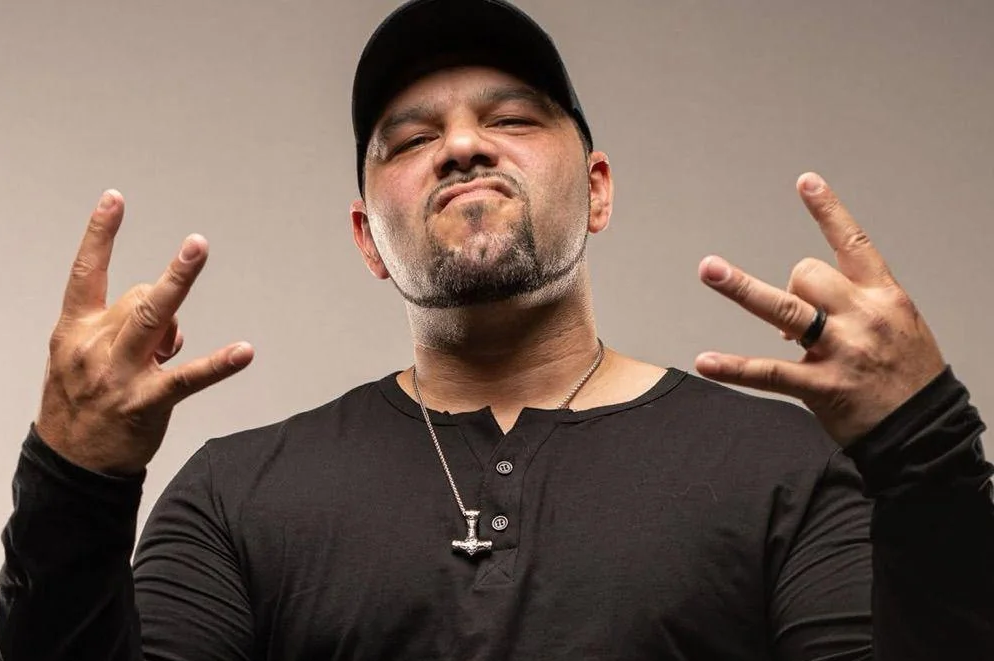
Music and professional wrestling are long-term bedfellows. From the Golden Age and starts such as Sgt. Slaughter and The Fabulous Freebirds, to the Attitude Era's numerous dalliances with hard rock and hip-hop, to modern day musicians even getting into the ring, tunes and turnbuckles have been a pairing for some time. At the forefront of this tag team today is Mikey Rukus, composer for All Elite Wrestling, a company that has gone from a bet between a journalist and the grandson of a plumber to a multi-billion dollar media empire in less than a decade. We've featured no shortage of Rukus' tunes here, but recently, I got to chat with the producer and composer ahead of this weekend's Revolution pay-per-view, pulling back the curtain on his creative process, his seamless blending of styles, and what is coming down the pike for AEW Music in year eight and beyond.
Lucia Z. Liner: So according to your Twitter, you’re learning violin. Tell me a little bit about that.
Rukus: It’s something I’ve wanted to do for quite a while, a couple of years. I consider myself a street musician. I’ve learned everything with no formal training since my teenage years. I had a guitar class in high school where we learned basic scales. In jazz band, we learned improvisation. But I taught myself how to play drums. I learned everything else outside of basic major and minor scales and blues scales. I learned my own chord progressions and everything. I don’t read sheet music. I just continued to craft things. I’m a percussionist by heart, and being Latino and growing up in a musically eclectic household, especially my mom, there was always banging. Everywhere. I was always a percussionist at heart, and then I delved into other instruments as I got older.
I’ve been using virtual strings for years. If I program drums into a grid, I understand how a percussionist thinks. So I know where the ghost notes lie, I know about the dynamics, I know about the techniques, so I can recreate those to make them sound authentic, like someone’s live-tracking. I can’t do that with strings. I have a basic understanding, but because I don't know the instrument itself, I have to guess everything. I don’t know if there are runs I’m putting together that don’t make sense on the instrument itself. I know some of the names of the techniques, but I don’t quite understand them.
Mrs. Rukus bought me an electric violin a while back, I went to go tune it, and my first interaction with it was that the tuning peg wouldn’t stay stuck.
LZL: Oh no.
R: It got to the point where I was like, “I gotta make this happen.” I’m at an age now where I still want to learn new things, I still want to challenge myself. I talked to a few instructors in my area, and I found one who understood exactly how I learn. She understood that I don’t read music, she understands how I learn, and she understood how I had taken the music I had made myself and turned it into a living. She says, “I can help you with this,” and so I’ve had one lesson so far. I go once a week, and I usually practice every morning what I’ve learned. Hopefully somewhere down the line, I’ll be able to incorporate some violin techniques into the music. I will also be moving to the viola and the cello as well. That’s something that’s on my plate and something that I wanna do. I want to see it through.
LZL: I was seeing on Twitter where you didn’t read sheet music, so I was wondering if you used tablature or learned by ear or how you did it. So when you’re composing themes, like right now, folks are talking about Tommaso Ciampa’s, “My Shadow Knows” - which is awesome, I have to say.
R: laughs Thank you.
LZL: So how does your process work if you’re not using sheet music? Are you plotting out melodies and such? How does that work?
R: My entire process is internal. Over the years, working a full-time job when I was on the come-up, I had very little time to sit and fiddle around with things and make it happen. If I work a ten hour day, then go to the studio and only have four hours in the studio, or if I only have a small window of time the next day or whatever, or I have a day off, I have to know what I’m going to do before I get in there. So all the writing and structuring happens in my mind. Sometimes I’ll use a voice memo so I can remember things. When I fire things up and turn all the gear on, I already know what I’m gonna do. I don’t really write things out, minus some lyrics. It’s all about understanding the vibe and what the sections are going to be. Once you’ve had the idea of how much time you have on TV and how our presentation works, you know what will fit where. When the time is right, you push the envelope just a little bit to help tell the story that the talent wants to tell.
That’s the case with Ciampa. We had a conversation back and forth, and he sent some examples of songs he really likes. I knew we had maybe a day and half to put everything together. From our first conversation to getting to the office maybe an hour later, I already had an idea of what I wanted to do. I wanted to keep it simple but strong and thunderous, something memorable. Everything you heard in that song, it came from Ciampa’s ideas, the hum, the way it repeats, the way the music drops out when he steps onto the turnbuckle, these were all his ideas. I just had to execute his vision. And it’s easy to see sometimes where talent have a basic idea of what they want, but they conflate ideas to examples that other people have. Then you gotta help steer them away from it and be like “well someone’s already got this.” Ciampa had his vision, it was unique, and it made the whole process that much easier.
LZL: The collaboration you’ve had with a lot of the talent is great to hear. I’ve seen some of your breakdowns of your process and some of your stories online. Adam Cole’s theme comes to mind. You mention the musicality of things, and I think of Adam Cole with the “BOOM!” and the thumb gesture. With Ciampa’s theme, you had a day and a half. Is that a typical turnaround for you? Or what is the timeframe you’re working with, generally speaking?
R: It’s always case by case. The average is two, three days, sometimes a week. Now that we’ve been doing this for a few years, I can see things coming down the pike. Sometimes we get surprises, like Ciampa’s was a complete surprise, and I knew we had a small window. There are others where I’m communicating with the talent, and there’s no timeline set up to when the change is gonna happen, or what story arc their character is gonna take. Then other times there is a load of work that needs to get done very quickly. At this point, we’ve been through so many iterations of crunch time and that, I don’t even think about the time constraints.
So yeah, usually it’s two, three days, sometimes a week. It’s all about the decision-making process, getting to the heart of what the talent is trying to tell, and getting it done as quickly as possible, regardless of what the timeframe is.
LZL: No, for sure. Sometimes it’s a spur of the moment thing, sometimes it takes a while. I know with today’s wrestling culture being as spoiler-happy as it is, with social media and that, I guess you never really know. So going back to the violin talk, you’ve had these offshoot EPs you’ve been able to record and release through AEW Music, like the symphonic versions of themes, or the acoustic versions of themes. Does this mean we’ll get more of that in the near future.
R: Yes. There’s some stuff I’m developing now. I’ve pitched a couple ideas with Tony [Khan, AEW Owner/CEO] a couple weeks ago, and now that the violin and that have come into play, I’m gonna give myself some time so it doesn’t sound like a first grader recording it. laughs
LZL: Sure, sure. laughs
R: I took a break from that kind of stuff after Hayter Rave 2 [a megamix of different AEW wrestler themes, named for former AEW Women’s World Champion Jamie Hayter]. I had to take a step back, cuz that was a four-month process, on top of doing everything for TV. This was right after the acoustic album, which was a lot of fun, but then I had to handle some things personally, then I launched my own business on the side, the toy business. So I needed to take some of my personal time back and focus on areas outside of that. Now that we’ve got this huge wave of momentum with AEW, and all of this new talent coming through the door, it’s brought on a lot of new things. I like doing those EPs cuz that’s my learning process. It’s something I can work on on the side, and tweak and fiddle with it till I like it. So we have things coming down the pike with that, but in terms of what that will be, we’re still figuring that out. Hopefully we’ll be able to share something soon.
LZL: Branching off of that, I was surprised to find that AEW Music is on Bandcamp. I guess with a bigger company like AEW, I wouldn’t expect to see it on a platform like Bandcamp. What was the thinking behind putting things there, as opposed to just streaming platforms and such?
R: Well, we just launched in 2019, and we started from complete scratch. So I looked at it as being someone who’s not just writing music for TV, but someone who’s a musical artist, reaching out and shaking the hands of fans like an artist handing out demos. At the same time, I had to make it available to as many people as possible, cuz we were creating an audio footprint from virtually nothing. With streaming platforms, they do 44.1, 16-bit audio, whereas Bandcamp gives listeners FLAC files, I can upload at 48Hz and 24-bit wavelengths. It was something I could do to give those who really value music quality when they’re listening, and you can’t always get that from streaming. So that was the idea behind it and it stuck.
LZL: It goes beyond just being a monolith of AEW Music, it’s getting deeper into what you’re doing. To that end, I wanna talk about your album Bring The Rukus. For fear of not burying the lede, are we ever gonna get a follow-up to that? Cuz there was some interesting stuff.
R: It’s funny, cuz over the last six or seven years with AEW, I’ve created over 400 tracks. There’s a lot of stuff that gets played constantly, there’s stuff that gets played one time. People would always ask, “How is that you have these bands with ten- or fifteen-year careers with thirty or forty songs, but you’ve written four hundred?” Well it’s two things. One, I’ve spent the last seven years telling other people’s stories. It’s been longer than that, really, cuz I started doing music for MMA and independent wrestling back in 2010, so we’re going on 16 years of telling everyone else’s story, and I’ve only had one album telling my story.
I’ve had a lot of changes personally, and my approach wouldn’t necessarily be the same as I had on the album. We will get a follow-up, but I haven’t decided if it’ll be an EP or a full album. There will be heavy elements, but the subject matter will be a lot different, what I’ll be discussing will be… I mean, I’m older now. I’ve gone through different things. Though I’ve gone from age 44 [at the time the album came out] and now I’m 50, there’s a lot of things that happen and a lot of perspective that’s gained in those years. I haven’t nailed down exactly what I want to do. If I do drop a second album, I wouldn’t want it to be what people heard the first time, I would want them to hear the evolution of what I’ve gone through and my personal journey.
LZL: Seeing the music you’ve released recently with AEW, you have so much. “My Shadow Knows” has that Southern gothic kind of feel, this ominous hard rock vibe. You have the song you did with Victor from The Wrestling Club for Hyan and Maya World, that was really cool. That was a nice little touch to see that extra thing, like “hey, by the way.”
R: Going back to that New Jack kinda swing, that Nineties hip-hop vibe.
LZL: To that end, I love Eddie Kingston’s theme “Cold World,” with that sort of nu metal take on DMX-style delivery. That’s one of my personal favorites that you’ve done.
R: Thank you for that. I remember having those conversations with Eddie when we put it together. Going for that DMX style, that almost Castlevania feel, with hip-hop and guitars. Then Blass [89, rapper], he’s from Eddie’s neighborhood, I think, rapped on that as well. I love jumping into different genres, studying the nuances of each. That’s why I haven’t pulled the trigger on a new album yet, cuz I’m not sure which direction I want to go. I was joking with my boys, cuz I fell in love with EDM, studying up for the first Hayter Rave. I talked about doing an Old Man Rukus EP, where it’s just me screaming like “get off my grass grass grass!” And just fill it with cliches that old people tell young people, like “why don’t you get a job?” I love all different styles, and it’s like learning new languages, and it’s like you never really stop learning.
LZL: Oh man, Old Man Rukus.
R: Oh man, we had a whole concept where I’d be dressed up like an old man, come crawling up to the stage and then get to the turntables and blow peoples’ eardrums out with this heavy-ass bass. Then be like “if I told you once, I told you a million times, stay off my fucking graaaaaaass!”
LZL: I would check that out, I can’t even lie, can’t even joke. So when a lot of folks think of music for pro wrestling, they think of Jim Johnston [famed WWF/E composer], they think of Jimmy Hart in WCW, Dale Oliver with TNA. What kind of influence did those folks have on you in making the sandbox you’ve crafted for yourself?
R: Of course I grew up with Jim Johnston’s soundtrack. I have a laundry list of his tracks that are my favorites, cuz I was a kid when I heard them. When you’re young and highly impressionable, they’re gonna stick with you. When I was a kid, television was a destination, especially with pro wrestling. There’s moments that become staples in your life, and there are songs that get attached to those moments.
When I started doing this, it was out of a need for supplemental income at that time. Back in 2010, it was CFO$ with WWE and that was it. I was working in the MMA industry, doing music for regional fighters and amateur fighters. As that grew, I wasn’t watching wrestling. But the fundamentals of Jim and what he did and those tracks, that stuck with me. Then signing with AEW, I further developed an understanding of what moments mean in TV presentation, framing and formatting something for television. Comparing AEW’s entrances to WWE’s or even TNA’s, there’s a different way that television is presented. What you have to do is form your own lane based on what’s best for the company’s presentation, and everyone has to be on the same page for it. The influence was there when I was figuring it out for myself, and now that I’m with AEW, we’ve figured it out for the company, and we’re able to work together and do our own thing.
LZL: Now I gotta ask, then, if we’re specifically focusing on Jim Johnston, what are some of your favorite themes of his?
R: Oh, The Brood by far.
LZL: Yes! I’m here for that.
R: You know, Brock [Lesnar]’s music is always gonna be great, but The Brood is always gonna be my number one. I love Goldust’s music, I love The Undertaker’s music, but The Brood’s was something different. It set the vibe. It wasn’t the most powerful, it didn’t have a singular melodic riff, but the track itself set the aura.
LZL: I’m glad you mentioned Goldust, cuz I feel like that theme doesn’t get enough love. It’s one of those that doesn't get its flowers.
R: Yeah, and the funny thing is that I can hear all of the stringed elements as a kid and you envision someone playing along. Again, it’s those songs that helped set the aura. That’s not to say that it’s just the music. You gotta have everyone on the same page. It takes a village, you gotta have the right lighting, the right camera angles. You gotta have everything working in sync, so that it all comes together.
LZL: Absolutely. Outside of wrestling, you’d mentioned coming from a musical family with percussion and all that. What other music is on your playlist? What do you listen to when you’re not writing or you’re getting ideas?
R: Funny enough, I used to consume so much back in the day. I’d go through these phases where it was just film music. Harry Gregson-Williams, Alan Silvestri, Michael Giacchino, Tyler Bates, you know, some of those guys. John Powell, Steve Jablonski, a lot of the modern film composers. Then other times, it’d be nu metal. Sevendust was a big one for me. I would go back and listen to some Coal Chamber. I was more of a fan of their bass player and her technique, watching how she played. Of course, old school Metallica. Megadeth, cuz of Dave Mustaine’s riff writing. As far as hip-hop, Busta Rhymes has always been my number one. Busta Rhymes, 50 Cent, DMX, Onyx, you know, those guys. The ones that are really loud and over the top, those are the ones that I got into.
Now a lot of the music I consume is from music that talent is sending me, cuz I wanna get into what they’re listening to. It’s funny, cuz now I spend so much time with headphones on and listening to music, that when I’m not in the office, I won’t listen to it. Even now, my youngest son is doing his thing, producing some hip-hop tracks. And I’m not just saying this cuz he’s my son, but he’s really good. He’s got his little three piece and they’re learning the ropes of production and stuff like that. Outside of that, it’s what talent is sending me. Or if Mrs. Rukus and I are chilling out in the living room, we have MTV Classic on, you know, the Rock Block that comes on or Nineties Jams or I Want My Eighties.
LZL: There you go.
R: I’m a nostalgia guy, so it’s all good.
LZL: Well we know a thing or two about nostalgia at The Nu Metal Agenda. I don’t know if this is overstepping, but I know there are a handful of wrestlers who use licensed music for their entrance themes. Do you have any input on that? Or is there a case where you can pitch them things? How do you factor into that? Like right now, we have Kazuchika Okada using One OK Rock’s song “C.U.R.I.O.S.I.T.Y” for his theme.
R: So it’s a case-by-case basis. Sometimes I’m involved in the conversation, sometimes I’m not. Like in Okada’s case, he had already had that idea for a while, and it was just a matter of going through the proper channels. Let’s say, and this isn’t like licensing out a popular track. Recently, The Rascalz came in, and they had a track they were using previously in TNA. That track is in the library that we have access to, so talking with Tony, I was like “We have that track, it only makes sense for them to use that track,” and he said, “that’s a great idea.” In the early days of AEW, I was involved in the licensing process. When we first left Daily’s Place post-COVID, we had a package that basically said “see you soon, we’re back on the road.” We used The Dirty Heads’ “Celebrate” for that, and I helped to pitch and negotiate for that deal specifically for that piece. That’s a part of our AEW history.
But it is a case-by-case basis. We have an extensive and intelligent legal team that goes after tracks. Sometimes I’m in the conversation, sometimes I’m not. It’s nothing I take personal, it’s just the flow of things. Some people are dealing with some on one aspect, some are dealing with another aspect. At the end of the day, whatever works best for the company and for the talent at that time. Ultimately, it’s gonna come down to Tony’s decision. If he thinks it’s great, then great. If he doesn’t, if he thinks, “hey let’s try something else,” then we try something else. It’s all over the place, there’s no one set way it goes. I just wanna tell the best story possible, and if that means we license a track for somebody, then we license a track for somebody.
LZL: Are we going to see more of you performing on pay-per-view? I ask because it was All Out 2021 with Muelas de Gallo, when you guys played Lucha Brothers out to the ring. It’s one of my favorite performances. Is that something you’re pushing for, to get out there a bit?
R: I never say never, but at the same time, I don't actively pitch to be on TV. There’s a million other people that deserve that time, and if I’m called to be a part of it, great, but I'm not gonna get broken up about being on TV. I had my band No One Hero, we had a couple other iterations and did some local shows. It’s not a driving force behind what I do anymore. Before, I wanted to prove I can still perform, while I’m producing. As you get older, you learn where your strengths are and what’s needed for your team. So you focus on where you’re supposed to be, then if you’re called for a spot, you go to that spot.
LZL: No, I get that. I’ve had a similar experience myself.
R: Even now, I don’t travel to TV as much as I did in the beginning. I wanted to have face time with my coworkers and my teammates. And as we got busier, I was best meeting the needs of the company being in my office and in my workspace. If I’m at a pay-per-view or a Dynamite, I get anxiety, cuz there’s work I have at home that needs to be caught up on. Plus things come up, you never know when something could change, and I want to be ready as much as possible. They call me, I need to be on the ready, at the ready, and that means I’m in my office. And I’m totally fine with that. It actually makes things a lot easier.
LZL: That’s fair, that’s fair. We had mentioned the side business, Got ‘Em Toys, as well as your podcast. Tell me about that, the nostalgia that you’re offering.
R: My business partner and I, he goes by the name of KeepinItWill, he was the best man at my wedding, back in 2010. We did a podcast for a couple years where we had wrestlers on to talk about their favorite movies, do some scenes and things like that. We both got busy and we had to put that to the side. Then in May of last year, we came across a big thing of toys from like, late Seventies all the way to like 2023. It was storage units upon storage units, and we came across the owners and they were looking to get rid of everything. We negotiated for about a week, and then we took possession of everything. We’ve been doing our thing ever since then. I built a website, gotemtoys.com, and we do conventions every now and again. And like Totally Rad Vintage Fest, that’s kinda become our thing. We did WrestleCade this last year. Just having a lot of fun getting back in front of people.
I was in retail for 30 years before I walked away from it to join AEW, so it’s been fun to get back to it, putting stuff in people’s hands and that. These things mean so much to people, like they may seem insignificant to some people cuz they’re toys, but those toys, you never know what toy means something to someone. This could have been like, sometimes we get stories like “I had a house fire and I don’t what happened to this toy, but you guys have it and you’ve reconnected me to it and given me closure.” We’ve had a blast. We’re hoping to sell every last bit of it, cuz it’s over 250,000 pieces.
LZL: Wow. That is insane.
R: And some of it is still with the original Toys R Us stickers on ‘em. We had boxes that were sealed, the owner did bulk purchases when they liquidated. They were trying to sell it themselves, but then they got upside-down in it and they’d been looking to get rid of it for three years. We just so happened to oblige them, and every day has been a new discovery.
LZL: I really feel like, the more I think about it, folks… I’m not calling myself old by any means, but toy shows like what you described is like our antiquing. Like I see my folks going to antique malls and craft shows and the like, but for my age bracket, it’s toy shows and record shows and conventions, things like that. Having those “where were you?” moments.
R: Absolutely.
LZL: And you mentioned being in retail previously, so what a full-circle moment now with Got ‘Em Toys.
R: Sometimes I have that moment of just, “What the hell am I doing? Why did I agree to this?” I spent my entire life trying to break away from this, here I am six or seven years later, I’m back in it again! But it’s all good. I learned a lot about myself and how to interact with people, understanding different peoples’ perspectives from all the years in retail. And I have so many good memories of those times, except the headaches and the long hours and that, you know. It is what it is, we’re doing good with it. We have our eBay page, we have our site set up, and we do our shows. We’re doing alright.
LZL: We’re finding ourselves more in the time where the Eighties was the cultural flashpoint in general, but now it’s the Nineties and the early 2000s, seeing that moving up and having those moments of “oh god, that was twenty years ago.” But it seems like you’re trying to celebrate that.
R: Absolutely. And the cool thing about it is that we were all kids in the Eighties and Nineties, now we’re the spending bracket. Now we have adult money to get the stuff we couldn’t have as kids. Actually, nostalgia purchasing is a billion-dollar industry now, so it makes sense.
LZL: I haven’t seen any statistics on that myself, but I don’t think I need to. It’s just that “oh hey, that’s a thing!” and then $20 later, you’re like “oh shit, well, that was fast.” So we’re coming up on seven years of AEW, what are your goals moving forward? What do you want to achieve with the music department and your corner of the market that is All Elite Wrestling?
R: It’s kind of hard to believe it’s been seven years, first of all. It’s been the honor of a lifetime to do this, like the amount of people that got to do what I’m doing, you can list on maybe one hand. So I don’t take that lightly at all. The thing I would like to see is me growing even more than I have in the last seven years. I’ve learned so much in this time about music production, TV production, all of it in these last seven years than I have in my entire working career. Not just giving people a chance to collaborate, but give back to the wrestling business.
I have plans for something that I want to do personally, give people the chance that have aspired to do this, to do it. Whether it’s people who want to feature on an AEW track, or teaching producers what I’ve learned in my time. You know, there’s no right way to do it, but I want to be able to show people how I do things, cuz when I was coming up, no one showed me. I had to figure it out on my own. So the best way I can give back is to impart that on others. And I wanna see more people working with younger talent across the board, and see bonds form between producers and indie wrestlers, and watch them grow up together. It’s like when you get producers and composers fresh out of college, they meet people, they network, and then thirty years later, they’re still working together. I would love to see something like that.
LZL: Yeah, keep that going and leave things better than you found them. I’m here for that.
R: Absolutely.