Nu metal was born in 1994 with Korn’s debut self-titled LP, even though it had been gestating for years prior. Generally speaking, folks point to 2004 as the “death” of nu metal, after bands like Killswitch Engage and Lamb of God gave birth to the New Wave of American Heavy Metal (NWOAHM), following on from the New Wave of British Heavy Metal (NWOBHM) in the Seventies and Eighties. Debates can carry on until the end of time as to the true beginning and end dates, but discussion about nu metal’s biggest day, its watershed moment, is much clearer.
The year is 1998. Pro wrestling is firmly embroiled in the vaunted Monday Night Wars, with the WWF championing its Attitude Era with “Stone Cold” Steve Austin, whose iconic entrance theme borrows from proto-nu heroes Rage Against the Machine, at its forefront. The Clinton administration is in grave danger, in a time where a hummer from an intern was an impeachable offense but declaring war without congressional approval wasn’t. And in the music world, the alternative was reigning supreme, between the funk-infused Red Hot Chili Peppers, grunge gods like Soundgarden, and this weird little genre called nu metal.
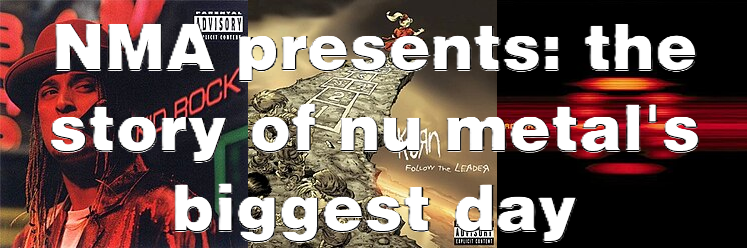
On August 18th, 1998, nu metal reigned supreme, with three albums from three of the genre’s biggest names dropped on the same day, marking a great day for the mall goths and the tribal-tattooed. Even still, these three albums couldn’t be more different from one another, showing that for a genre that gets shoehorned into frat-boy shenanigans is actually far more diverse than people think. From the seven-string rattles and eerie leads of Korn’s Follow The Leader, to the hip-hop braggadocio of Kid Rock’s Devil Without A Cause, to the industrial croon of Orgy’s Candyass, this triumvirate of tunes gave nu metal its coming-out party, just four years after its proper debut.
These three albums represent the true depth of nu metal. People tend to have a very finite vision of nu metal when the term is uttered, but this day helps to show the range. All three albums can claim the label of nu metal, but they sound radically different. Korn brings in elements of funk and hip-hop, even bringing in nu metal cohort Fred Durst and N.W.A.’s own Ice Cube. Kid Rock leaned on his Detroit area, blue-collar roots to make, as he once professed, a "redneck, shit-kicking rock 'n' roll rap" record. Orgy, having just formed a year prior, leaned heavy into industrial and electronic elements, bringing in some of the goth scene, who were no doubt familiar with New Order, whose song “Blue Monday” was one of two singles on Candyass, exposing a new generation to a timeless synthpop song.
Korn kicked off the genre proper some four years prior with their self-titled debut, mixing haunting imagery and ambient sounds with crunchy seven-string riffs and thumping bass. It was their nod from comic book artist Todd McFarlane, best known as the creator of Spawn, that helped form the look of this album cycle, as McFarlane had called Korn “The Doors of the Nineties” in talks with Epic’s vice president of marketing, Al Masocco. As such, the band approached McFarlane to do the cover art for Follow The Leader, and not only did he provide that, but he also directed the music video for the album’s lead single and the song that Korn is perhaps best known for, “Freak On A Leash.”
The album’s production, however, was a bumpier ride. Though he stayed on as a vocal coach for frontman Jonathan Davis, Ross Robinson did not make a three-peat for producing Korn, as Steve Thompson produced with Toby Wright performing mixing duties… at least at first. In an interview with Kerrang!, Jonathan Davis talks about firing Thompson and having Wright slot in as producer, which did delay production for weeks as parts needed to be re-recorded. On that subject, say what you will about Korn being weirdos, but given the recording of the album opener “It’s On!” taking place with, according to Davis, people engaging in sexual acts innumerable all around him in the studio, as well as Wright demanding an eight-ball of cocaine before he’d begin tracking the vocals, it doesn’t get much more rock and roll than that.
So often, the genre is written off as obnoxious, but in the late Nineties, Kid Rock embodied the everyman. His “redneck pimp” persona won over Lava Records head Jason Flom, picking up a cool $150K to make his major-label debut, his studio output already three LPs deep by this point. Sure enough, the hick-hop of “Cowboy” and the funky rhythms of “Bawitdaba” pushed back against the teenybopping fare of the late Nineties, while putting someone at least marginally relatable in the spotlight.
In 2026, it’s hard to believe that Kid Rock was actually cool at one point, but a to-date total of fourteen million records sold tell the story. The influence is felt today, as without the hybridization that was “Cowboy,” there may not be an “Old Town Road” upon which to take our horses. Rock’s Twisted Brown Trucker Band boasted Uncle Kracker, who would break out on his own a year later with No Stranger To Shame, with a cover of Mike Berry’s “Drift Away” serving as a breakthrough.
Orgy were a band on the rise in the summer of 1998, as Candyass served as their debut album. The name of the band allegedly comes from the intermingling of all the different genres at play in the music, rather than directly referencing group sex. The band were quickly signed to Elementree Records, the label owned and operated by Korn’s Jonathan Davis, forever linking the two bands. Davis has performed in the band Sexart with guitarist Ryan Shuck, and their time together led to Orgy being the first band signed to the imprint, which was distributed by Relapse Records.
There were indeed too many cooks in the kitchen for Candyass, as names including Troy Van Leeuwen, Josh Abraham, Dave “ohGr” Ogilvie, and Deadsy frontman Elijah Blue Allman were among those on the record. While the first single “Stitches” saw the band crack three Billboard charts, it was their cover of New Order’s “Blue Monday” that took the album and the band to stardom, even landing the band a number one placement on the Hot Dance Music/Maxi-Singles Sales chart. Arguably, this also led to more nu acts covering dance hall classics, as the following year saw Dope cover Dead or Alive’s “You Spin Me Right Round (Like A Record)” and Coal Chamber cover Peter Gabriel’s “Shock The Monkey.”
If Woodstock 1999 was nu metal’s most infamous day out, August 18th, 1998 was the calm before the storm. Between these three records, some twenty million records have been sold. All three acts are still going in some form or another, albeit to varying amounts of success. While Korn are going strong and touring, Kid Rock has had trouble shifting tickets despite his MAGA grifting, and Orgy have been accused of playback over-reliance since their 2023 appearance at Sick New World Festival. While the grasp on the zeitgeist of each Korn, Kid Rock, and Orgy may vary, their collective talents - and yes, debauchery, in many aspects - led to nu metal’s wave of popularity to close out the Nineties.
If we take the years of 1994 to 2003 as the lifespan of the original run of nu metal, 1998 was its prime, with even more to come in the following year. Bigger things would be on the horizon, as this is still a year before Limp Bizkit’s breakout album Significant Other and Static-X’s debut Wisconsin Death Trip. As such, this day is something of a college graduation for nu metal, as it walked across a stage and into the real world, one that frankly was not ready for it.